
Understanding the Tensions Leaders Are Navigating Right Now
Over the first quarter of 2026, we have spent time inside leadership teams across a wide range of organizations. From city leaders navigating growth and public expectations to managers stepping into larger roles while still carrying the weight of their day-to-day work, the environments differ, but the conversations have felt strikingly similar.
Most leaders are not asking what they should know. They already understand what good leadership looks like. The real tension shows up in execution. In the meeting where expectations are not clearly stated. In the initiative that starts strong but loses traction. In the hesitation to address an issue directly because of the relationship at stake.
Across these conversations, three topics surfaced more consistently than any other.
Issue #1: Accountability Is Expected but Often Avoided Under Tension
WHAT WE ARE SEEING
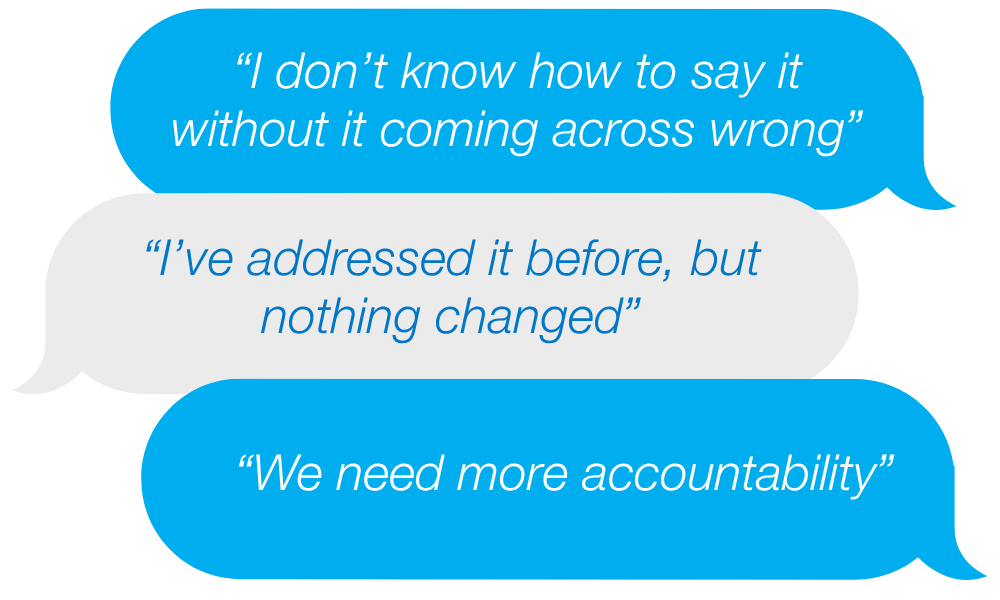
Across organizations, accountability is one of the most talked-about leadership needs. Leaders consistently express a desire for stronger ownership, follow-through, and performance from their teams. At the same time, many admit they are unsure how to address gaps without creating tension or damaging relationships.
- Leaders struggle with timing, language, and follow-through in performance conversations
- Expectations are often implied rather than clearly stated
- Issues are addressed late, after frustration has already built
WHAT’S REALLY GOING ON
The challenge is not a lack of desire for accountability. It is a lack of clarity and structure around it.
In many cases, expectations are not defined at a level that allows for true ownership. Leaders assume alignment, but teams are operating from different interpretations of success. When performance falls short, the conversation becomes more personal than practical.
There is also a natural tension leaders feel. They want results, but they also want to maintain strong relationships. Without a clear approach, accountability starts to feel like confrontation instead of leadership.
WHAT’S WORKING
Make expectations observable, not implied.
Strong leaders are getting specific about what success actually looks like. Not just the outcome, but the behaviors, timelines, and standards required.
A simple shift that works:
- Before work begins, align on what success looks like
- What does progress look like along the way
- What will we check in on and when
Clarity upfront removes the need for difficult conversations later.
Separate the person from the performance.
Leaders who handle accountability well are able to address the work without making it personal.
A practical framework:
- Start with the shared expectation
- Describe what is happening versus what was agreed upon
- Ask for perspective before jumping to conclusions
- Re-align on what needs to happen next
This keeps the conversation grounded in the work, not the individual.
Issue #2: Teams Are Busy but Not Aligned

WHAT WE ARE SEEING:
Many teams are moving quickly, but not always in the same direction. Leaders are communicating priorities, holding meetings, and pushing initiatives forward, yet alignment across the organization remains inconsistent.
We hear this show up in a few consistent ways. Leaders talk about communication being the issue.
Departments operate in silos. Priorities feel clear at the top, but less so as they move through the organization. Even when effort is high, the results feel fragmented. Work is getting done, but not always contributing to the same outcomes.
WHAT’S REALLY GOING ON:
The root issue is not a lack of communication. It is a lack of shared understanding.
Leaders often believe they have communicated clearly because they have said something once or twice. But across teams, people are interpreting priorities differently. Each group is making decisions based on their own context, which leads to misalignment over time.
In many organizations, there is also no consistent rhythm for reinforcing what matters most. As new demands emerge, priorities begin to compete with one another, and focus gets diluted.
Without a shared mental model of what success looks like and how work connects, alignment breaks down even when communication is frequent.
WHAT’S WORKING
Reinforce through rhythm, not reminders.
Alignment is not created in a single message. It is built through repetition.
Effective teams are establishing simple rhythms to stay aligned. This might look like a weekly check-in on top priorities, or regularly asking:
- What are we focused on right now
- Where are we off track
- What needs to be realigned
When alignment becomes part of the operating rhythm, teams stay coordinated even as conditions change.
Create a shared definition of priority.
Leaders who are improving alignment are not just communicating more. They are simplifying and repeating what matters most.
A practical approach is to narrow focus to a small set of priorities and consistently reinforce them across settings. Team meetings, one-on-ones, and project conversations all point back to the same few outcomes. Over time, this builds clarity and consistency in how people make decisions.

Issue #3: Leaders Are Carrying Too Much and Developing Too Little
WHAT WE ARE SEEING
Across organizations, leaders are stretched thin. Many are responsible for key initiatives, day-to-day operations, and team performance all at once. As demands increase, their time is pulled toward immediate work, leaving little space to develop others.
We consistently hear leaders express some version of the same challenge. There is not enough time. Development gets pushed to the side. Important conversations are delayed.
In many cases, leaders are still deeply involved in the work themselves while also trying to lead others. Over time, this creates a bottleneck where both execution and development begin to suffer.
WHAT’S REALLY GOING ON
This is not just a time issue. It is a capacity and role shift issue.
As leaders take on more responsibility, the work they are accountable for grows faster than their ability to personally manage it. Without intentionally shifting how they operate, they continue to carry work that should be shared or developed in others.
There is also a level of risk involved in letting go. Developing others requires time, patience, and a willingness to allow learning to happen through experience. Many leaders default to doing the work themselves because it feels faster and more certain in the moment. Over time, this limits both the leader and the team.
WHAT’S WORKING
Create space for development before it feels available.
One consistent pattern is that development never happens when leaders are waiting to have extra time. The leaders who are making progress are building it into their existing work.
This can be as simple as:
- Using project work as a coaching moment
- Having shorter, more frequent one-on-one conversations
- Asking more questions instead of immediately providing answers
Shifts like these allow development to happen alongside the work, not separate from it.
Shift from doing the work to building the capability.
Leaders who are increasing capacity are making a deliberate shift in how they view their role.
Instead of asking, “How do I get this done?” they are asking, “Who can grow through this?”
This does not mean handing work off without support. It means intentionally using real work as a development opportunity, even if it requires more time upfront.
What This Means for Leaders
Accountability, alignment, and capacity are not separate issues. They are closely connected. When expectations are unclear, accountability becomes difficult. When teams are not aligned, execution slows. When leaders are carrying too much, both performance and development begin to suffer.
The leaders making the most progress are not trying to solve everything at once. They are focusing on a few key shifts. Getting clearer on expectations. Repeating what matters most. Creating space to develop others through the work.
If these patterns reflect what you are experiencing in your organization, you are not alone. These are shared challenges across many teams right now, and they can be addressed with the right focus and structure. If it would be helpful to talk through what this could look like in your context, we would welcome the conversation.