
Why smart teams fall out of alignment and how to fix it
The meeting starts the way they always do: on time, with a full calendar, and good people in the room.
Marketing kicks things off. “We need to push harder on growth this quarter. Pipeline is light, and we’re falling behind.”
Product leans forward. “We can’t keep shipping at this pace. The platform is getting unstable. If we don’t slow down, it’s going to cost us more later.”
Sales jumps in before anyone can respond. “We’re losing deals because we’re too rigid. We need more flexibility in what we’re offering, not less.”
Customer Success shakes their head. “We’re signing the wrong customers. That’s why churn is creeping up. This isn’t a growth problem, it’s a quality problem.”
Finance adds one more layer. “We’re already over budget. None of this works unless we control spending.”
The room goes quiet for a moment, not because anyone is wrong, but because everyone is right. Each perspective makes sense on its own. Each argument is grounded in real data, real pressure, real responsibility. But together, they don’t add up to a clear direction. They cancel each other out. So the conversation loops. People restate their points. They defend their priorities. They try to find a middle ground, but it feels forced. Nothing actually resolves. By the end of the meeting, there is no decision. Just a vague sense that something is off.
Later, someone will say the teams feel siloed. Someone else will say communication needs to improve. Leadership might even call for better alignment. But sitting in that room, the problem feels harder to name. How can a group of smart, capable people all be right and still be completely out of sync?
Misalignment Isn’t About Competence
It’s tempting to walk out of that meeting and diagnose the problem quickly. Communication needs to improve. Teams need to collaborate more. People need to get on the same page. Those explanations feel reasonable. They are also incomplete.
Because if this were just a communication issue, repeating the message would fix it. If it were just a collaboration issue, getting people in the same room would solve it. But you just saw what happens when all the right people are in the room, saying smart things, and still not moving forward. The real issue runs deeper.
Each person in that meeting is operating from a different understanding of what matters most right now. Not because they are misinformed, but because their role has shaped how they see the business. None of these perspectives is wrong; in fact, they are all necessary. The problem is that they are not anchored to a shared understanding of how those pieces fit together. What you are seeing is not a failure of effort or intelligence. It is a misalignment of mental models.
A mental model is the internal map people use to make decisions. It tells them what to prioritize, what to ignore, and how to judge success. Over time, teams build their own versions of this map based on their goals, metrics, and daily pressures. That is how organizations quietly drift into misalignment, not through one big mistake, but through the accumulation of slightly different assumptions about reality. So when people come together to make decisions, they are not just bringing opinions. They are bringing entirely different frameworks for how the business works. And without realizing it, they are solving different problems in the same conversation.
Alignment Has Layers
At this point, it’s easy to label the problem as disagreement, but what looks like disagreement on the surface is usually something deeper. People are not just debating ideas. They are operating from different layers of understanding about what the company is trying to do and how it should be done. So when a conversation gets stuck, it is rarely about the decision in front of you. It is about misalignment sitting a few layers above it.
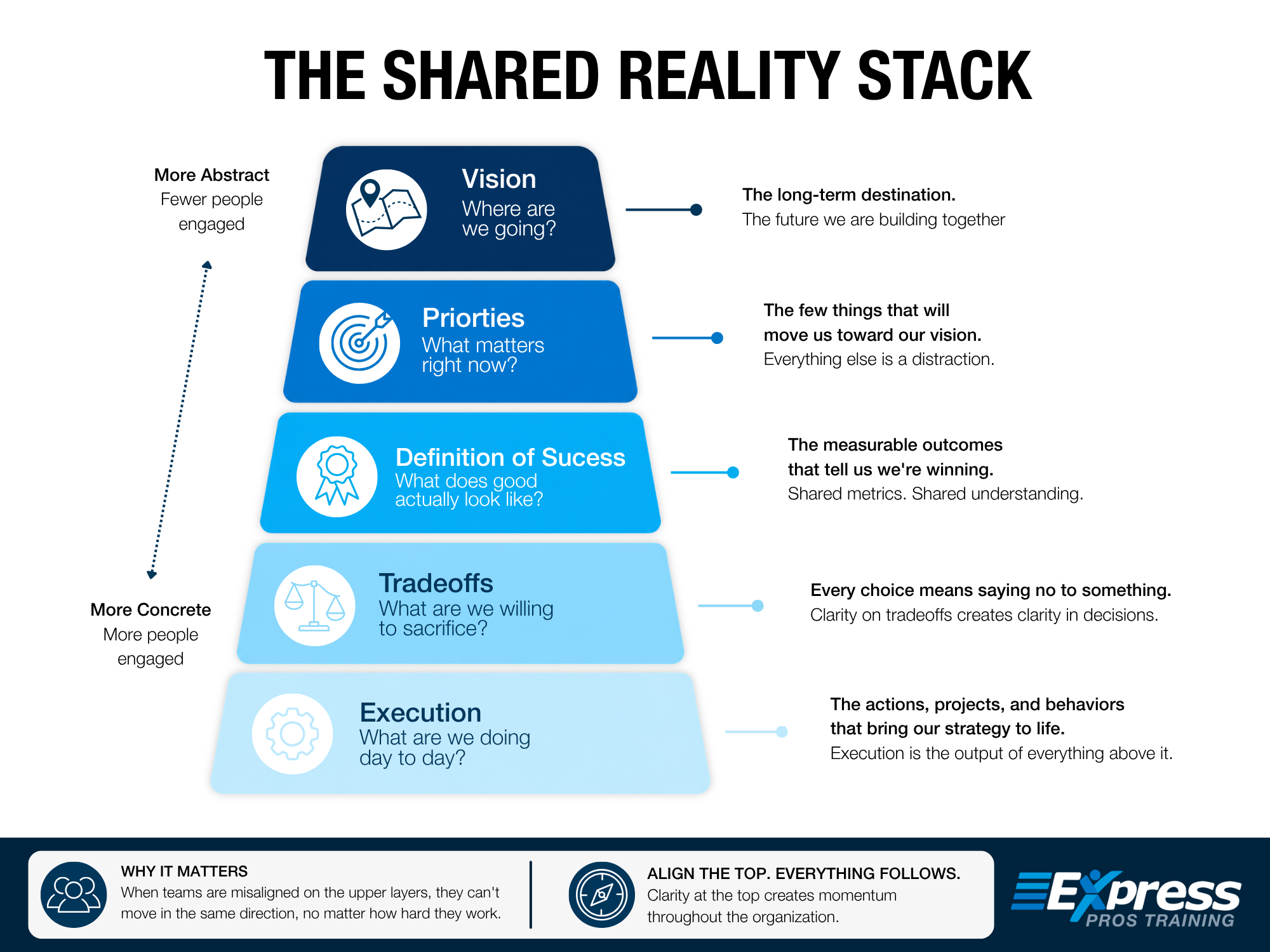
Level 1: Vision Where are we going?
This is the long-term direction. Not a slogan, not a slide in a deck, but a clear understanding of what the company is trying to become. If teams interpret the vision differently, they will make very different decisions that all feel justified.
Level 2: Priorities What matters right now?
Even with a clear vision, teams need to know what takes precedence in the current moment. Growth or efficiency. Speed or stability. Expansion or consolidation. If priorities are not explicit, every team will default to what makes the most sense for them.
Level 3: Definition of Success What does good actually look like?
This is where many organizations quietly break. Two teams can agree on a priority like growth, but define success completely differently. One may optimize for volume, another for quality. Without a shared definition, progress in one area can look like failure in another.
Level 4: Tradeoffs What are we willing to sacrifice?
Every strategy implies sacrifice, but most organizations avoid stating it directly. When tradeoffs stay implicit, teams make their own calls. That is how you end up with conflicting decisions that all seem reasonable in isolation.
Level 5: Execution What are we doing day to day?
This is where most alignment conversations focus. Tasks, timelines, deliverables. But execution is the output of everything above it. If the upper layers are misaligned, execution will reflect that no matter how well people collaborate.
Teams usually align at this bottom layer. They attend the same meetings, work on shared projects, and communicate regularly. But if they are not aligned on vision, priorities, success, and tradeoffs, they are not actually moving in the same direction. They are just working hard in parallel.
How Leaders Build a Shared Reality
Most leaders are clear on what decisions have been made. Far fewer take the time to explain why those decisions exist in the first place. Saying “we are focusing on growth” sounds directionally helpful, but it leaves too much open to interpretation. Why growth over profitability right now? What changed? What does that mean for how teams should operate differently?
When people understand the reasoning behind a decision, they are far more capable of making aligned choices on their own. Without that context, they fall back on the mental models shaped by their own function, which is exactly how misalignment begins to creep in again.
Clarity also requires discipline around priorities. In many organizations, everything carries a sense of urgency, which means nothing truly stands out. When priorities are not explicitly defined and constrained, teams will decide for themselves what matters most. That is how siloed thinking quietly reinforces itself, even in companies that believe they are aligned. Real alignment comes from making hard calls visible, not just about what matters, but about what does not.
And perhaps most importantly, none of this works as a one-time effort. Alignment is not something you announce and move on from. It has to be reinforced continuously. People join teams, priorities evolve, and context shifts. What feels repetitive to leadership often feels like new information to everyone else. Consistency, over time, is what holds the system together.
The goal is not to eliminate different perspectives. Those differences are valuable and often necessary. The goal is to ensure that those perspectives are grounded in the same understanding of where the company is going, what matters right now, and how success is defined. That is what turns a group of capable individuals into a coordinated organization that can actually move forward together.

Alignment Is a System, Not a Message
One of the most common traps organizations fall into is treating alignment like a one-time communication. A strategy gets announced, a leadership offsite happens, a polished deck is shared, and there is an assumption that everyone will now move forward in sync. But alignment does not work that way.
It is not something you declare and move on from. It is something that gets reinforced, or undermined, every single day. It lives in the rhythms of the organization. It shows up in which priorities leaders revisit in weekly meetings, which metrics get attention, and how decisions are made when things get messy. Over time, these signals carry far more weight than any single message ever could.
When those signals are consistent, alignment strengthens. When they are not, even the clearest strategy begins to drift.
Now go back to that meeting. Same people. Same constraints. Same competing perspectives. But this time, something is different. There is a shared understanding of where the company is going and what matters most right now. Priorities are not implied; they are explicit. Success is not left open to interpretation; it is clearly defined. The tradeoffs have been named, so no one is quietly optimizing for a different outcome.
The conversation still has tension, but it moves forward. People are not talking past each other anymore. They are working through the same set of assumptions, the same definition of success, the same reality. That is what alignment actually does. It does not eliminate disagreement, but it makes disagreement useful. Because the problem was never that people saw things differently. It was that they were never grounded in the same understanding to begin with.
And the truth is, building that kind of alignment is not simple. It does not happen quickly, and it rarely happens by accident. It takes intention, repetition, and a willingness to make things clearer than they feel like they need to be.
That is exactly the work we help organizations do.
We partner with leadership teams to define vision in a way that actually guides decisions, to clarify priorities so teams know what truly matters, and to build alignment systems that hold up under pressure. Not as a one-time exercise, but as something that becomes part of how the organization operates.
If this feels familiar, it is probably not a small issue. But it is a solvable one, and it is worth getting right.