
When you’re leading an organization, it’s easy to assume the challenges you’re facing are unique. Then you spend time with another leadership team…and another…and another…and you begin to realize many of them are wrestling with remarkably similar questions.
That’s what this Quarterly Field Report is about.
It’s not intended to be research or a collection of leadership theories. It’s simply a reflection on the patterns we’ve observed while working alongside leaders over the past few months. Some of these observations may confirm what you’re already seeing. Others may give you a different way to think about the challenges in front of you.
Observation #1: Leadership Gets More Complex as Organizations Grow
What we’re seeing
One of the conversations we’ve had several times this quarter goes something like this:
“We’ve grown a lot over the last few years, but somehow leadership feels harder than it used to.”
It’s an interesting observation because growth should make things easier, shouldn’t it? More people. More talent. More resources. And yet, many organizations describe the opposite. Communication becomes more difficult. Decisions take longer. Priorities compete for attention. Leaders spend more time coordinating work and less time leading people.
What’s interesting is that these challenges often don’t appear because something is wrong. They appear because the organization has changed.
What’s really going on
Think about a small organization. When there are twenty people, everyone knows what’s happening. Conversations happen naturally. Leaders can walk down the hall, answer a question, and make sure everyone is moving in the same direction.
Now imagine that same organization after several years of growth.
There are more departments. More initiatives. More decisions. More leaders involved in every conversation. The habits that once kept everyone aligned begin to strain under the weight of a more complex organization.
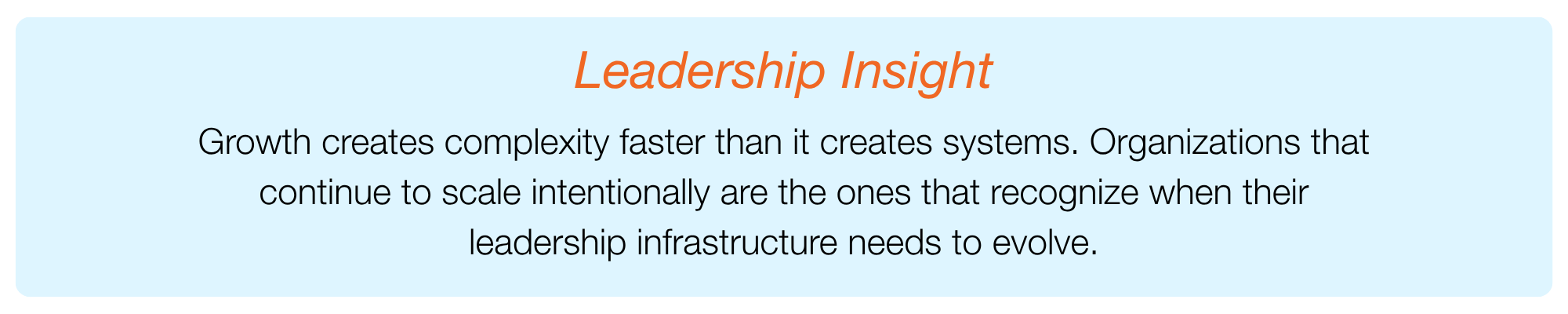
That’s why growth changes the job of leadership. Leaders can no longer rely on informal conversations or assumptions to keep people aligned. They have to become much more intentional about creating clarity, reinforcing priorities, and helping people understand how their work connects to the larger picture.
What’s working
The organizations navigating growth most effectively aren’t necessarily communicating more. They’re communicating more intentionally.
They’re creating regular rhythms for alignment. They’re clarifying how decisions are made. They’re revisiting the leadership habits that worked when the organization was smaller and asking whether those habits still fit where they are today.
Growth doesn’t automatically require new leaders. Sometimes it simply requires leaders to lead differently.
Observation #2: Look Past the First Problem
What we’re seeing
Here’s another conversation we’ve had several times this quarter.
A leader tells us they’re dealing with burnout. Or communication problems. Or a lack of accountability. Or an employee who just doesn’t seem engaged anymore.
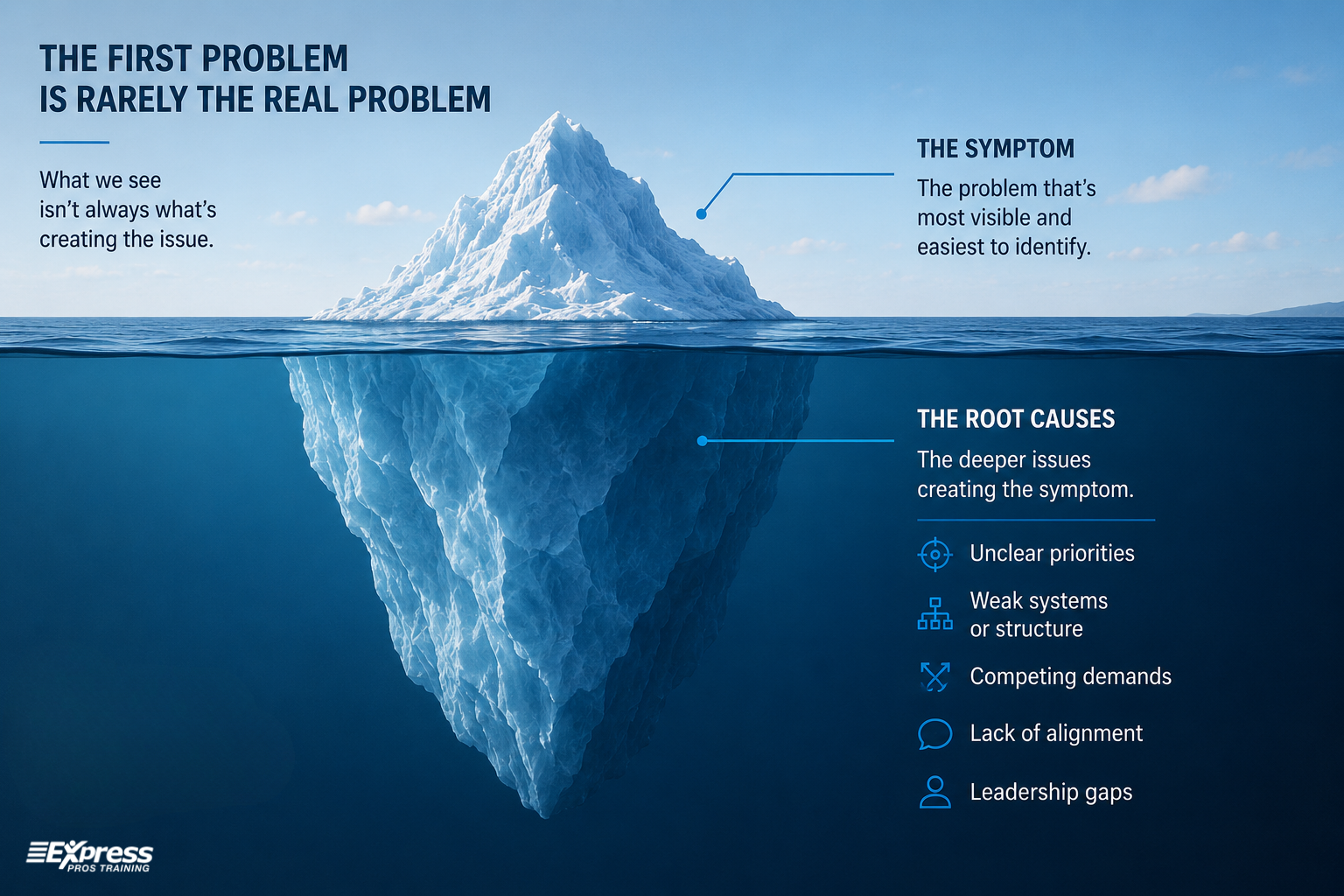
Those are all real challenges. But we’ve noticed something interesting. The first problem leaders describe is often just the most visible one.
What’s really going on
Think about your car’s dashboard. When the “check engine” light comes on, no one assumes the light is the problem. The light is simply telling you that something underneath the surface needs your attention.
Organizations work the same way.
Burnout may be pointing to competing priorities. Communication problems may actually be an alignment issue. Missed deadlines may have less to do with performance and more to do with unclear expectations.
One of the conversations that stuck with us this quarter started with burnout. By the end of the discussion, no one was talking about burnout anymore. We were talking about priorities, workload, and the conditions that made burnout almost inevitable.
That’s an important shift. Great leaders learn to look beyond the symptom and ask what might be creating it.
What’s working
The leaders making the most progress aren’t necessarily solving problems faster. They’re slowing down long enough to understand them.
They’re asking questions like:
What conditions made this likely?
What changed?
What else could be contributing to this?
Those questions don’t just lead to better answers. They often lead to entirely different conversations. And that’s where lasting improvement usually begins.
Observation #3: Leadership Starts with the Person in the Mirror
What we’re seeing
One of the more subtle patterns we’ve noticed this quarter has to do with where leaders place their attention when challenges arise.
It’s natural to look first at what’s happening around us. Communication isn’t where it needs to be. Another department isn’t following through. Senior leadership hasn’t made a decision. The team isn’t taking enough ownership. Those challenges are real, and they deserve attention.
What we’ve noticed, however, is that the leaders making the greatest progress tend to begin somewhere different. Before focusing on what everyone else needs to change, they first ask themselves, “What part of this situation can I influence?”
That shift may seem small, but it often changes the entire direction of the conversation.
What’s really going on
Leadership has always been about influence, and influence begins with ownership.
As organizations grow, it’s easy to believe that progress depends on someone else making the first move. We wait for another department to communicate more clearly, for senior leadership to provide direction, or for the team to become more engaged. Sometimes those things do need to happen.
But we’ve found that waiting rarely creates momentum.
The leaders creating the healthiest cultures aren’t ignoring the obstacles around them. They’re simply choosing not to let those obstacles become an excuse for standing still. They look for the next conversation they need to have, the expectation they need to clarify, or the relationship they need to strengthen. They focus on the part they can own, trusting that ownership will influence the people around them.

What’s working
The leaders we’ve seen make the greatest impact this quarter have one thing in common: they consistently act on what is within their influence instead of becoming consumed by what isn’t.
That doesn’t mean they solve every problem on their own. It means they choose to move the conversation forward. They ask the difficult question. They clarify the expectation. They take the first step instead of waiting for someone else to do it. And when one leader begins taking ownership, it often gives others permission to do the same.
What This Means for Leaders
Every quarter reminds us that leadership is less about having the right answers and more about continuing to ask the right questions.
This quarter, we saw organizations wrestling with growth, leaders learning to look beyond the first problem, and teams making the most progress when someone chose to take ownership instead of waiting for someone else to act. While those may seem like separate observations, they’re all pointing to the same reality: leadership becomes more intentional as organizations become more complex.
The encouraging news is that none of these challenges have to be permanent. They can all be improved. Healthy organizations aren’t built by accident. They grow because leaders are willing to pause, reflect, and make small adjustments that compound over time.
That’s the work we get to be part of every day.
At Express Pros Training, we partner with organizations to develop leaders, strengthen executive teams, facilitate strategic conversations, and help organizations navigate the challenges that come with growth. Whether you’re developing new managers, investing in your leadership team, or thinking through the future of your organization, we’d love to be part of that journey.
If this quarter’s observations reflect what you’re seeing in your own organization, let’s start a conversation.