
That is the idea behind our Quarterly Field Report. It is a reflection of what we have seen and heard through our work over the past few months, giving us a pulse on what managers and leaders are navigating right now. More importantly, we hope it offers a helpful perspective on what may be happening beneath those challenges and a few practical ideas for moving forward.
This quarter, three observations continued to surface in our conversations.
Observation #1: Everyone Heard It. Did Everyone Understand It?
What We’re Seeing
One of the more common assumptions we have seen this quarter is that because something is clear in a leader’s mind, it must also be clear to everyone else.
Most leaders are communicating. They are holding meetings, sending emails, talking through priorities, and explaining decisions. In many cases, leadership teams are communicating with one another regularly. Yet when we begin asking people to explain what was decided, what matters most, or what is expected next, we sometimes discover very different answers.
That is an important distinction. Communication may have happened without shared understanding being created.
What’s Really Going On
We often use the term mental models to describe the picture each of us carries in our mind about how something works. We have mental models for our organization, our priorities, our roles, and even what words like accountability, urgency, or good customer service actually mean.
The challenge is that leaders often have much more context than the people they are leading. A leader may have spent weeks thinking about an issue, participated in several conversations about it, considered different options, and finally arrived at a decision. By the time they communicate that decision to the team, it feels incredibly clear.
But the team wasn’t in those conversations. They don’t have the same context, and they may be interpreting what they hear through a very different mental model.
The same thing can happen within a leadership team. Everyone can leave the same meeting believing they are aligned, only to discover later that they had different understandings of what was decided or what the priority actually was.
The goal of good communication, then, isn’t simply to transfer information. It is to create shared mental models.
What’s Working
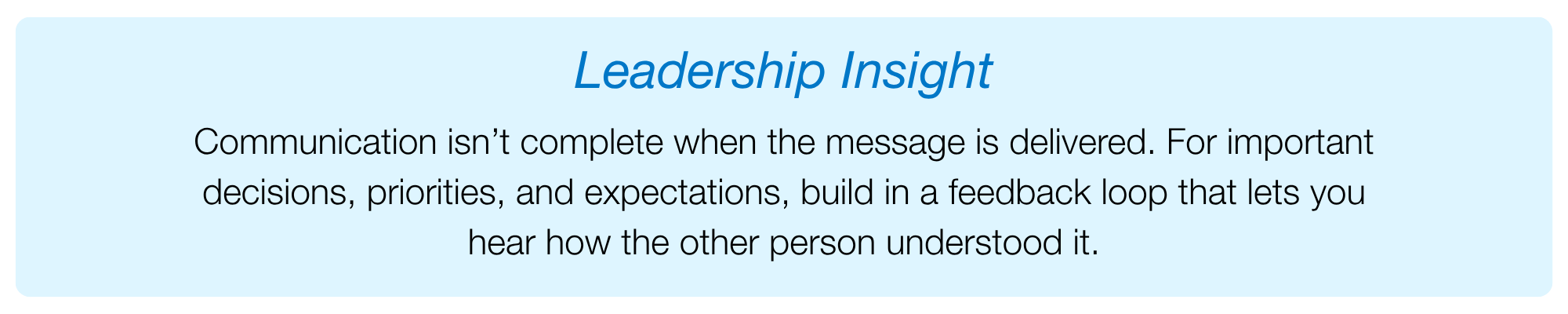
One simple practice we have found helpful is what we might call a playback. At the end of an important conversation, rather than asking, “Does everybody understand?” ask someone to play back what they heard: “Before we leave this, tell me how you understand what we’ve decided, why it matters, and what happens next.”
That question does something “Does everyone understand?” rarely does. It gives the leader a chance to hear the mental model that actually formed in someone else’s mind. For leadership teams, the question can be adjusted slightly: “If each of us explained this to our teams tomorrow, would they hear the same message?”
The point isn’t to make every conversation longer. It is to recognize which conversations matter enough that assuming clarity is more expensive than taking a few minutes to confirm it. Sometimes the communication problem isn’t that we haven’t said enough. It’s that we haven’t taken the time to find out what the other person actually heard
Observation #2: Doing It Yourself Feels Faster. Until It Isn’t.
What We’re Seeing
One of the patterns we have noticed this quarter is how difficult it can be for managers to let go of control. Sometimes that shows up in delegation. Other times it appears in decision-making, problem-solving, or simply allowing someone else to approach the work differently than they would. One leader summed up the thinking well: “I do it right every time. It takes too long to teach them.”
What makes this interesting is that most of these leaders genuinely want their people to grow. The tension comes when developing someone else requires the leader to give up some control over how the work gets done.
What’s Really Going On
There is a reason control can be difficult for leaders to give up: control often works in the short term. If I can complete something in twenty minutes that would take me forty-five minutes to teach someone else, doing it myself seems like the responsible choice. The task gets finished, I know it is done correctly, and I can move on to the next thing.
The problem is that next week I am still the person who has to do it.
We saw that tension show up in several ways this quarter. In one conversation, the issue underneath a leader’s behavior was described simply as control rooted in fear. In another, we talked about the difference between completing tasks and developing people. Tasks give us the immediate satisfaction of getting something done. Developing people takes longer, the outcome is less certain, and there may be some mistakes along the way.
Done well, delegation is an intentional decision to create leverage while helping another person grow in capability. That requires a leader to accept something that can feel uncomfortable: sometimes the most productive thing I can do today will actually make today a little less efficient.
The payoff comes later. Someone else becomes more capable. The leader becomes less necessary to every decision and task. The organization gains capacity that did not exist before.
What’s Working
When you catch yourself thinking, “It would just be easier if I did this myself,” pause and ask: Am I the only person who can do this, or am I simply the person who can do it fastest right now?
If someone else could eventually own the work, the next question becomes: What would I need to give them so they can succeed without me?
Maybe it is clearer expectations. Maybe it is training, context, authority, or a few intentional check-ins along the way. The goal isn’t to hand something off and hope for the best. It is to transfer responsibility in a way that builds capability.
There will always be moments when doing it yourself is the right decision. But when “it’s faster if I do it” becomes a leader’s normal operating model, today’s efficiency can quietly become tomorrow’s bottleneck.

Observation #3: Knowing Better Doesn’t Automatically Mean Leading Better
What We’re Seeing
Most of the leaders we work with already know a lot about leadership. They know communication matters. They know they should delegate, give feedback, develop their people, build trust, and address difficult issues before they become bigger ones. And yet, many of those same things continue to be difficult in practice.
One observation from this quarter captured the challenge particularly well: leaders often struggle to move from knowledge and intent to actual change. The issue isn’t always that a leader needs another idea. Sometimes the harder work is turning something they already understand into a consistent way of leading, especially when the demands of the day begin competing for their attention.
What’s Really Going On
Understanding something and being able to do it consistently are two different things. A leader can understand how to give good feedback and still avoid the conversation. They can understand delegation and still struggle to let go. And when the pressure increases, we tend to fall back on the behaviors that are most familiar to us, even when we know there may be a better way.
Real development happens when an idea begins to change our behavior. That usually takes time, intentionality, and repeated practice. It is one thing to recognize what good leadership looks like; it is another to practice it often enough that it begins to shape the way we naturally respond. That’s why leadership development can’t stop with insight. Knowing gives us direction. Practice builds capability.
What’s Working
We’ve been using a simple analogy this quarter: leadership skills are muscles. They get stronger when we use them.
If you want to get better at feedback, have more feedback conversations. If you want to become a better listener, practice listening. If you want to handle difficult conversations better, you need experience having difficult conversations.
Like any muscle, those skills develop gradually. The first few reps may feel awkward or uncomfortable, and you probably won’t get every one right. But each time you practice the behavior, you become a little more comfortable and a little more capable. Eventually, something that once required a great deal of intentional effort begins to become a more natural part of how you lead.
So choose one leadership muscle you want to strengthen and intentionally give yourself opportunities to use it. Don’t just ask, “Do I know how to do this?” Ask, “Am I getting the reps?” Over time, those reps become capability.
What This Means for Leaders
One of the threads running through this quarter’s observations is that it can be difficult to see our own patterns clearly. We may believe we have created clarity when others are walking away with a different mental model. We may not recognize how tightly we are holding onto control, or we may understand what good leadership looks like without realizing how inconsistently we are practicing it.
Sometimes leaders and teams simply need an outside perspective. That is a significant part of the work we do. We come alongside organizations and leadership teams to ask questions, observe what may be difficult to see from the inside, offer an objective perspective, and help turn good intentions into practical action. Just as importantly, we can provide the accountability that helps those actions become lasting changes rather than good ideas that get lost in the demands of the week.
If your leadership team could benefit from an outside perspective, a thoughtful challenge, or greater accountability around the things you already know matter, we’d welcome the opportunity to come alongside you.